
I Just Stay Busy
Recently I heard a public figure asked how they manage stress, depression, anxiety. The answer came quickly, almost without thinking: I just stay busy.
Said like it was obvious. Like it was the answer.
And honestly? It is the answer, for most of us. It's just not a good one.
It is one of the most accurate reflections of our culture, not because one person is alone in thinking this way, but because nearly all of us have lived by this exact philosophy at some point. Keep moving. Stay productive. Fill the calendar. Don't stop long enough to feel whatever is waiting underneath.
I know, because I did it for years.
The Seduction of Busy
There is something deeply seductive about busyness. It feels like purpose. It feels like importance. In a culture that equates productivity with worth, staying busy isn't just a coping strategy — it's an identity. A badge of honor. The busier you are, the more you must matter.
For most of my adult life, I lived inside that logic completely. I was a healthcare leader with a high-pressure career, climbing steadily, always reaching for the next level. My days were full from the moment I woke up. And when they weren't, I found ways to fill them — more emails, another project, another goal, another thing to optimize or achieve.
I told myself this was ambition. And some of it was. But a lot of it, I now understand, was avoidance.
Busyness is extraordinarily effective at keeping you away from yourself. When every moment is scheduled, there is no room for the uncomfortable questions. No space for the feelings that don't have neat explanations. No time to sit with the quiet, unsettling awareness that something might be off — in your life, in your relationships, in the story you've been telling yourself about who you are and what you want and why you want it.
Staying busy isn't just a distraction. For many of us, it's a survival strategy. And like most survival strategies, it works — until it doesn't.
What We're Actually Avoiding
When I talk about stillness, I'm not just talking about rest, though rest matters deeply. I'm talking about the particular discomfort of having nothing between you and yourself.
Boredom. Uncertainty. The feelings that surface when the noise stops. The thoughts you've been outrunning.
We live in a culture that has very little tolerance for any of this. We've built entire industries around helping people avoid it — streaming platforms, social media feeds, productivity apps, endless content designed to keep our attention moving so it never has to land anywhere long enough to actually feel something.
And then we wonder why anxiety is at epidemic levels. Why so many people feel a vague but persistent sense that something is missing. Why we reach, constantly, for the next thing — the next goal, the next drink, the next scroll — and still don't feel satisfied.
We are not burned out from doing too much. We are burned out from never stopping. There's a difference. One is about volume. The other is about never letting yourself recover — not just physically, but spiritually, emotionally, in whatever way feels true to you.
The Morning I Actually Stopped
The other morning I went to a yoga class. I'll be honest — I wasn't sure I wanted to be there. It had been a long time, and I'm not someone who loves every style of movement, I was expecting deep stretch and when the downward dogs and flow started being instructed I was annoyed. But I stayed.
And something happened that I wasn't expecting.
As I moved through the poses, I started to feel things I couldn't name. Not emotions exactly — more like sensations. Like something releasing. At moments I felt like I could fall asleep. At others, something was loosening that I hadn't even realized was held. And when the class was over, I walked out into the morning air with a kind of calm I hadn't manufactured or earned or chased down. It was just there.
That is what stillness — real stillness, even the moving kind — can do.
It's not always comfortable. In fact, it often isn't. Sometimes what surfaces when you slow down is grief, or frustration, or the quiet sadness of time that felt wasted. Sometimes it's just a profound, unfamiliar sense of peace. Sometimes you don't even know what you're feeling. You just know it's real in a way that your busy days rarely are.
This is what I think so many people are missing. Not relaxation exactly — though that too. But the actual felt experience of being alive in a body, in a moment, without an agenda.
The Other Thing We've Forgotten: Slowness
There's a difference between stopping and slowing down — and we need both.
Stopping gets all the attention. Meditation. Rest days. Unplugging. But slowing down is its own practice, and in some ways it's more radical, because it asks you to change the pace of your actual life — not just carve out an hour away from it.
Think about how you move through a workday. The expectation, spoken or unspoken, is always faster. Answer the email the moment it arrives. Jump between tasks. Fill every gap. In healthcare, where I've spent my career — both as a leader and now as a consultant — this pressure is especially intense. There is always more to do. Another patient, another process, another initiative that needed to be done yesterday. The system runs on urgency, and after long enough inside it, you start to believe that urgency is just reality. That this speed is simply what's required.
It isn't. Most of it is manufactured.
And the cost is enormous — not just to individuals, but to the quality of the work itself. You cannot think clearly at that pace. You cannot make good decisions. You cannot be present with the people in front of you. Faster is not always better. Often it's just louder.
Slowing down doesn't necessarily mean doing less. It means doing things more fully. It means letting a task take the time it actually takes instead of rushing through it to get to the next one. It means pausing before you respond instead of reacting. It means eating your lunch without looking at your screen. Walking to your car at the end of the day without immediately putting something in your ears.
That last one matters more than it sounds. We have filled every transitional moment of our lives with input — podcasts, music, news, self-improvement content. Even our downtime has become productive. Even our walks have an agenda. We are so committed to optimization that we can't take ten minutes outside without turning it into a learning opportunity.
What if you just walked? No headphones. No podcast. No playlist. Just the sound of the world around you and your own thoughts moving at their natural pace. Not because it will make you more productive afterward. Not because it's a wellness hack. Just because you are a person, alive in a body, and that body deserves to exist in the world without a soundtrack for a few minutes.
That is slowing down. And it is available to you right now, today, in the life you already have.
The Permission You're Waiting For
I want to say something directly, because I spent too many years waiting for someone to say it to me:
You are allowed to stop.
Not just on vacation. Not just when you're sick. Not just when you've earned it by being productive enough. You are allowed to build stopping into your ordinary days, for no other reason than it is good for you and good for your life.
Rest is not laziness. Space is not emptiness. Stillness is not wasted time.
The urgency you feel — the sense that there is always more to do, that you're falling behind, that sitting still is somehow dangerous — that urgency is largely constructed. It has been handed to you by a culture that benefits from your busyness, your distraction, your consuming. Most of it is not real.
What is real is this: you will not get this time back. Not this day, not this season, not this version of your life. And the question isn't whether you were busy enough with it. The question is whether you actually lived it.
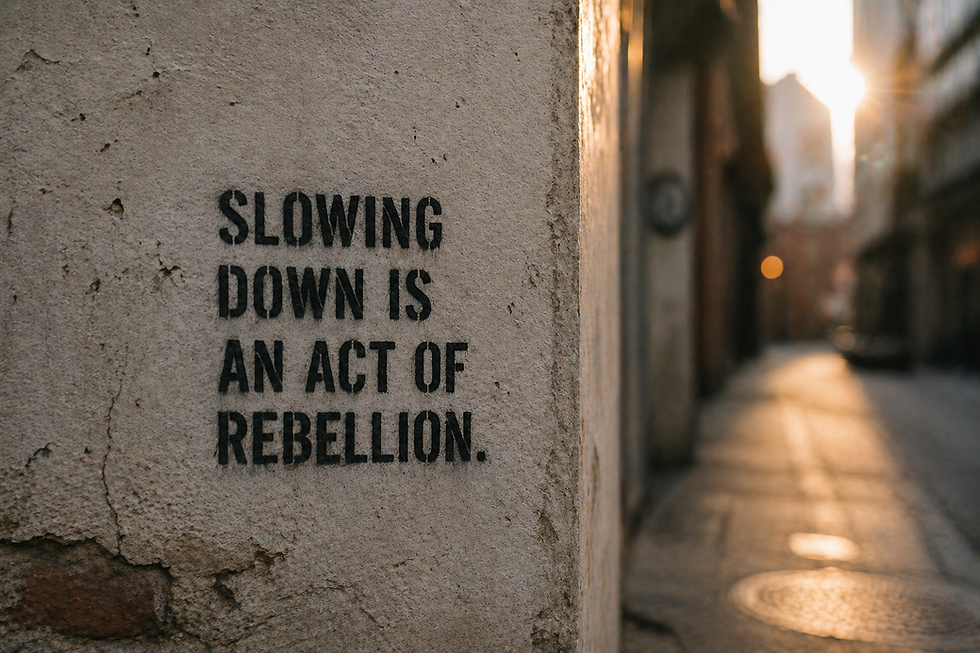
Slowing Down Is an Act of Rebellion
Here is something I've come to believe deeply: choosing to slow down in this culture is not passive. It is one of the most quietly radical things you can do.
Every rule we live by — the forty-hour work week, the always-on email culture, the idea that rest must be earned, that stillness is laziness, that your value is measured by your output — every single one of those rules was made up. By people. In a particular moment in history, for particular reasons. None of it is law. None of it is nature. All of it can be changed.
We have the intelligence. We have the resources. As a human race, we have built extraordinary things — and we have also built systems that are grinding people down, stealing their health, their relationships, their sense of self. That is not inevitable. It is a choice we keep making collectively, until enough of us decide to make a different one.
I am not naive enough to think one person's morning walk changes a broken system. But I do believe, genuinely, that culture shifts when individuals shift. When enough people stop performing busyness and start actually living, something moves. When you choose presence over productivity, even for ten minutes, you are practicing a different way of being in the world. And that practice builds. It spreads. It quietly asks the people around you what they might be avoiding too.
Slowing down is how we begin to change things. Not just for ourselves — for all of us.
What I am suggesting is smaller than it sounds, and harder than it looks.
Take a walk without headphones. Eat a meal without your phone face-up on the table. Let an email sit for an hour before you respond. Drive somewhere in silence. Sit outside for ten minutes and don't bring anything to do.
Notice the urge to fill the space — because it will be there, almost immediately, like a reflex. The reach for the phone. The impulse to put something on. The sense that doing nothing is somehow dangerous or irresponsible or a waste. That urge is information. It's telling you how rarely you actually let yourself just be.
Sit with the discomfort of having nothing between you and your own thoughts. Let your nervous system remember what quiet feels like. Notice what comes up — without immediately trying to make it stop.
You might feel restless. You might feel sad. You might feel nothing at all, and then wonder if something is wrong with you. Keep going. Stay a little longer than is comfortable. Trust that things are not burning down while you take a breath.
Because on the other side of that discomfort is something our culture has made very hard to find: yourself. Just yourself, exactly as you are, not performing or achieving or managing or optimizing.
Just alive. Just here.
That's worth more than busy.


Comments